
In today’s digital-first world, your website is often the very first interaction a potential customer has with your brand. You might have invested in clean design, fast loading speed, compelling copy, and even paid traffic—but if conversions still feel underwhelming, the problem may not be your product or pricing.
The real gap is trust. And that’s exactly where social proof comes in.
Social proof is no longer a “nice-to-have” element. It’s the deciding factor between a visitor who scrolls and leaves, and one who takes action.
What Is Social Proof—and Why Does It Matter So Much?
Social proof is the psychological principle where people rely on the actions and opinions of others to decide what to do. In simple terms, visitors ask themselves:
“If others trust this brand, can I trust it too?”
Online, social proof shows up as:
- Customer reviews and ratings
- Testimonials and case studies
- User-generated content (UGC)
- Brand mentions and recognitions
When done right, social proof reduces uncertainty, validates decisions, and shortens the buyer’s journey.
The Conversion Problem Most Websites Don’t See
Many websites fail to convert not because they lack information—but because they lack validation.
A visitor may like your product. They may understand your pricing. But one silent question still remains:
“Has this worked for someone like me?”
Without visible proof, visitors hesitate. They leave. And that hesitation compounds across every landing page, product page, and checkout step.
High-converting websites don’t just tell visitors they’re trustworthy. They show it.
Why Reviews Are the Strongest Form of Social Proof
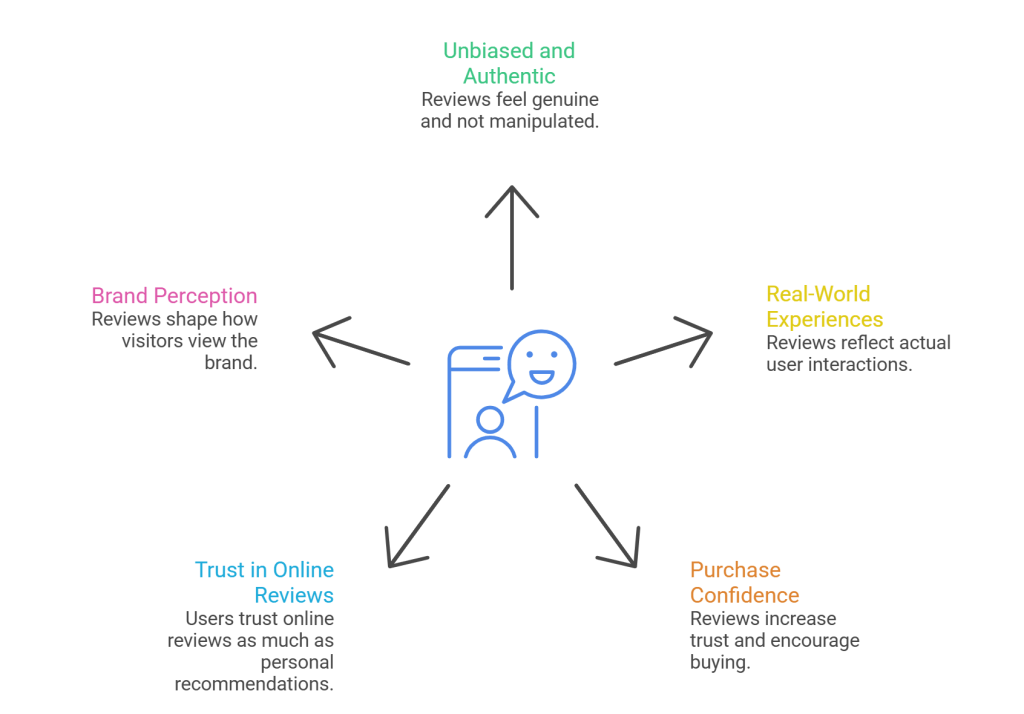
Among all forms of social proof, customer reviews hold unmatched influence.
Real reviews:
- Feel unbiased and authentic
- Reflect real-world experiences
- Directly impact purchase confidence
In fact, users trust online reviews almost as much as personal recommendations. A single well-placed review section can dramatically change how a visitor perceives your brand.
That’s why leading businesses actively display their reviews on high-visibility pages instead of hiding them on third-party platforms.
The Shift: From External Reviews to On-Site Trust Signals
Earlier, businesses relied on platforms like Google, Yelp, or Facebook to host their reviews. While those platforms still matter, modern conversion-focused brands take it one step further.
They bring reviews onto their own website.
When reviews live on your site:
- Visitors don’t need to leave to verify credibility
- Trust is built at the exact moment of decision-making
- Conversions happen faster
This is where tools designed specifically for review display become essential.
How a Google Review Widget Changes Website Behavior
A google review widget allows businesses to display real, verified Google reviews directly on their website in a clean, visually appealing format.
Instead of asking users to “check our reviews,” you put proof right in front of them.
When visitors see:
- Real customer names
- Star ratings
- Honest feedback
They stop questioning your credibility and start focusing on whether your product fits their needs.
That shift alone can significantly increase:
- Lead form submissions
- Checkout completions
- Demo bookings
Where Social Proof Works Best on a Website
To maximize impact, social proof shouldn’t be randomly placed. High-performing websites strategically display reviews at key touchpoints:
- Homepage: Establish trust immediately
- Product or service pages: Reduce purchase anxiety
- Landing pages: Reinforce ad claims
- Checkout pages: Prevent last-minute drop-offs
The goal is simple: show reassurance exactly when doubt appears.
Why Visual Presentation of Reviews Matters
Not all review displays are equal. A poorly formatted block of text won’t inspire trust.
High-converting websites use review widgets that:
- Match the website’s design
- Load quickly
- Are mobile-friendly
- Update automatically with new reviews
This is where platforms like Taggbox stand out.
Taggbox enables brands to collect, moderate, and display Google reviews seamlessly—turning raw feedback into polished social proof that blends naturally into any website layout.
Turning Reviews Into Conversion Assets
When reviews are presented correctly, they do more than build trust—they actively sell for you.
A well-placed review can:
- Answer objections without sales copy
- Highlight benefits through real experiences
- Validate pricing and quality
Instead of saying “We’re the best,” you let customers say it for you.
This approach feels authentic, human, and far more persuasive than traditional marketing claims.
How Businesses Embed Reviews Without Technical Hassle
Modern tools make it easy to embed google reviews on website pages without complex development work.
With the right widget solution:
- No coding expertise is required
- Updates happen automatically
- Design remains fully customizable
This allows marketing teams to focus on messaging and optimization rather than technical setup.
Social Proof as a Long-Term Conversion Strategy
Social proof isn’t a one-time tactic—it compounds over time.
As more customers leave reviews:
- Your website grows more credible
- New visitors convert faster
- Paid traffic performs better
Over months, this creates a trust-driven growth loop where every new customer helps bring the next one.
Final Thoughts
If your website isn’t converting as expected, the problem may not be traffic, design, or pricing. More often than not, it’s the absence of visible trust.
Social proof—especially customer reviews—is the missing piece that transforms hesitation into action.
By showcasing real experiences through a well-designed google review widget and leveraging platforms like Taggbox, businesses can turn their websites into confidence-building machines that don’t just attract visitors—but convert them.
In a world where trust decides everything, social proof isn’t optional anymore. It’s the foundation of high-converting websites.
 Review Widget
Leave a comment